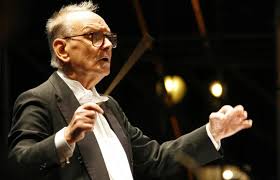
Ennio Morricone Biography : Songs, Movies And Concert 2026
Ennio Morricone was born on November 10, 1928, in the Trastevere neighbourhood of Rome, Italy, a working-class district of narrow cobblestone streets where music was not an abstract artistic pursuit but a daily practical necessity. His father, Mario Morricone, was a professional jazz trumpeter who played nightly in Rome’s clubs and music halls to support the family, and it was at his father’s side that the young Ennio first encountered the language that would define his entire existence. By the age of six, he was already writing down music he heard on the radio, transcribing melodies with a precision that suggested a mind wired differently from other children his age
You can also read: Sabastian Sawe Biography.
He entered the Conservatorio di Santa Cecilia in Rome as a trumpet student in his teenage years and completed a four-year harmony programme in just two years, graduating with diplomas in composition, band arrangement, trumpet, and choral direction. His primary composition teacher was the renowned Goffredo Petrassi, one of Italy’s most respected twentieth-century composers, under whose rigorous guidance Morricone developed a serious ambition to become a composer of avant-garde concert music. That ambition never fully left him, and it ran alongside his film work throughout his life, producing a catalogue of over 100 concert pieces in parallel with his incomparably larger body of work for cinema.
His early professional years were spent in the pragmatic work that most composers of his era had to do to pay their bills. He wrote arrangements for RAI, the Italian national broadcaster, worked with the RCA record label, and occasionally ghost-wrote film scores under the pseudonyms Dan Savio and Leo Nichols. His public debut as a film composer came in 1961 with Il Federale. Two years later came the decisive collaboration of his career, a reconnection with a former classmate named Sergio Leone, who was developing a new kind of western that would reinvent an entirely American genre. The result was the Dollars Trilogy, comprising A Fistful of Dollars in 1964, For a Few Dollars More in 1965, and The Good, the Bad and the Ugly in 1966, which created an entirely new sonic vocabulary for cinema.
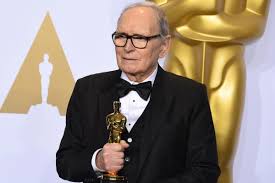
His score for The Mission in 1986, featuring the iconic piece Gabriel’s Oboe, earned him one of his many Oscar nominations. His score for Cinema Paradiso in 1988 became one of the most emotionally resonant pieces of film music of the late twentieth century. His score for The Hateful Eight in 2015, composed when Morricone was already 86 years old, finally brought him the Academy Award for Best Original Score. Added to his Lifetime Achievement Oscar in 2007, presented by Clint Eastwood, his full tally of awards includes two Academy Awards, three Grammy Awards, three Golden Globes, and six BAFTAs. He married Maria Travia on October 13, 1956, a union that lasted sixty-three years until his death and produced four children. He passed away on July 6, 2020, at the age of 91, in Rome, the city he had never wished to leave.
Ennio Morricone Songs
Ennio Morricone’s compositional output produced some of the most recognisable pieces of music in the entire history of cinema and popular culture, and several of his compositions have transcended the films for which they were created to become standalone cultural artefacts known by people who have never seen the movies that first contained them.
You can also read: Umashi Dhlamini Biography
The Ecstasy of Gold, composed for The Good, the Bad and the Ugly in 1966, is perhaps the most universally recognisable of his pieces outside of a strictly classical context. The heavy metal band Metallica has used it as their concert opening theme since 1983, playing it at the start of every show for over four decades and introducing it to multiple generations of rock audiences who discovered Morricone through that unlikely gateway. The piece builds with extraordinary structural logic, expanding into a soaring, spiralling soprano vocal line that seems to stretch beyond the physical limits of the human voice.
Gabriel’s Oboe, from The Mission, is considered by many musicians and composers to be the most purely beautiful melody Morricone ever wrote. Composed to represent a Jesuit priest’s first contact with the indigenous people of South America through the sound of a solo oboe, the melody requires no dramatic context to produce its effect. It is one of the clearest examples in all of film music of a single instrument carrying the full emotional weight of an idea.
Chi Mai, originally composed in 1971 and later repurposed as the theme for the 1981 French film Le Professionnel, became one of the most widely heard pieces of music in Europe in the early 1980s after it was used for a BBC television drama. It reached number two on the UK singles chart in 1981 and introduced Morricone to an entirely new audience. Deborah’s Theme from Once Upon a Time in America, the Love Theme from Cinema Paradiso, and the harmonica-driven main theme from Once Upon a Time in the West are further examples of a composer who never separated accessibility from artistic depth.
Ennio Morricone Movies
Ennio Morricone’s filmography spans over sixty years of cinema and encompasses more than 500 film and television scores across multiple languages, countries, and genres. His most defining body of work remains the Spaghetti Western films he scored for director Sergio Leone. A Fistful of Dollars in 1964 announced a new kind of film music. For a Few Dollars More in 1965 deepened that language, and The Good, the Bad and the Ugly in 1966 perfected it, producing what many consider the single greatest western film score ever recorded. Once Upon a Time in the West in 1968 added operatic grandeur, and Once Upon a Time in America in 1984 brought the collaboration to its most emotionally sophisticated conclusion.
You can also read: James Orengo Biography
Beyond Leone, his most celebrated work includes The Battle of Algiers in 1966, whose percussive score became as influential on political cinema as the Leone westerns were on action cinema. The Mission in 1986 and 1900 in 1976 demonstrated his capacity for large-scale historical epic. Cinema Paradiso in 1988 showed a more intimate, nostalgic warmth that won the hearts of audiences worldwide. The Untouchables in 1987, Bugsy in 1991, and In the Line of Fire in 1993 showed his range within Hollywood productions. His collaboration with John Carpenter on The Thing in 1982 demonstrated a completely different register of his imagination, tense, abstract, and deeply unsettling.
His Oscar-winning score for The Hateful Eight in 2015, composed at the age of eighty-six at the request of director Quentin Tarantino, one of the most publicly vocal admirers of his entire body of work, was a reminder that his creative powers had not diminished with age. Other notable titles in his filmography include Malena, The Legend of 1900, Days of Heaven, La Cage aux Folles, The Professional, and Disclosure, all of which demonstrate the extraordinary diversity of a composer who never once repeated himself.
Ennio Morricone Concert 2026
Ennio Morricone passed away in July 2020, but his music continues to fill concert halls and arenas across the world in 2026 through an extraordinary range of tribute performances, orchestral celebrations, and dedicated touring productions, each offering audiences the chance to experience his compositions live the way he always believed they deserved to be heard.
You can also read: Vaibhav Suryavanshi Biography
One of the most significant events in 2026 is the Ennio Morricone Original Celebration Concert, scheduled for November 11, 2026, at the O2 Universum in Prague. This concert carries a unique legitimacy because it is conducted by Andrea Morricone, the Maestro’s own son, himself a composer and conductor who spent years working alongside his father. Andrea leads The City of Prague Philharmonic Orchestra, accompanied by a large choir and soloists who worked personally with Ennio Morricone during his lifetime, including Italian soprano Vittoriana De Amicis, a regular presence on Morricone’s own concert tours, and guitarist Rocco Zifarelli, who performed with the Maestro at dozens of concerts over more than twenty years. The programme features Once Upon a Time in the West, The Good the Bad and the Ugly, A Fistful of Dollars, The Mission, Cinema Paradiso, and The Untouchables, with large-screen film projections throughout the evening.
At the Barbican Centre in London, the Madrid Philharmonic Orchestra is performing Ennio Morricone and 100 Years of Cinema, placing his compositions within a broader survey of cinematic music history. At Cadogan Hall in London, the Ensemble Symphony Orchestra under conductor Giacomo Loprieno is performing Discovering Morricone, a concert exploring lesser-known corners of his catalogue alongside familiar classics, with soprano Anna Delfino and Cirque du Soleil violinist Attila Simon. In Montreal, the FILMharmonique Orchestra under Maestro Francis Choinière is performing a tribute at Place des Arts. The touring production The Music of Ennio Morricone, performed by the all-female Italian ensemble Le Muse, completed a Finland tour in January 2026. In Milan, a tribute concert is being performed at the Teatro Verme. These events collectively confirm that six years after his passing, the appetite for Morricone’s music performed live has not diminished in the slightest. If anything, the absence of the man himself has made the music feel more precious, and those who perform it carry the weight of that responsibility with evident care and devotion.