David Allan Coe Biography : Net Worth, Cause of Death, Age And Wife
David Allan Coe was born on September 6, 1939, in Akron, Ohio, a working-class industrial city in the American Midwest that bore little resemblance to the sun-bleached western landscapes his music would later conjure so vividly. His early life was shaped not by music lessons or family stability but by a cycle of institutional confinement that began when he was just nine years old, when he was sent to the Starr Commonwealth for Boys, a reform school in Michigan. What followed was nearly two decades of being in and out of correctional facilities, including stretches at the Ohio State Penitentiary and the Marion Correctional Institution. For a boy without the anchors of a stable home, the prison system became a brutal but unexpectedly formative world.
It was inside those walls that the first seeds of his musical career were planted. Coe later spoke about meeting the flamboyant blues singer Screamin’ Jay Hawkins while incarcerated, a figure famous for the theatrical gothic blues of songs like “I Put a Spell on You.” Hawkins encouraged him to write songs and pursue music seriously. By the time Coe was released from his final prison term in 1967, he had committed to music completely. He arrived in Nashville with virtually nothing, parking a red Cadillac hearse emblazoned with his name in front of the Ryman Auditorium, the historic home of the Grand Ole Opry, performing on the street to anyone who would listen. That image, a tattooed man with long hair living in a hearse outside the most sacred institution in country music, was a perfect encapsulation of everything he was and would always be.
He was noticed. Shelby Singleton, owner of Plantation Records, signed him, and in 1970 Coe released his debut album, Penitentiary Blues. His early years in Nashville were defined by a maddening paradox. He was an exceptionally gifted songwriter whose compositions were eagerly sought by other artists, yet his own recordings struggled to break through. Tanya Tucker took his song Would You Lay With Me (In a Field of Stone) to number one in 1974. Johnny Paycheck turned his Take This Job and Shove It into a working-class anthem and another chart-topper in 1977, a song so culturally resonant it inspired a feature film of the same name. Yet Coe himself remained an underground figure, too wild and uncompromising for the Nashville establishment to fully embrace.
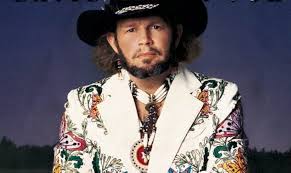
For a period he performed as The Mysterious Rhinestone Cowboy, wearing a black rhinestone-studded suit, a large black cowboy hat, and a mask across his eyes, an image inspired partly by his father’s advice that a mask gives a man freedom from his own fame. His first significant chart success as a performer came with his 1975 album Once Upon a Rhyme, which included the top-ten hit You Never Even Called Me by My Name, a sardonic comic song satirising country music’s conventions. The 1983 album Castles in the Sand brought him back with The Ride, a supernatural ballad about a hitchhiker encountering the ghost of Hank Williams, followed by Mona Lisa Lost Her Smile in 1984. He also holds the distinction of being the first country singer to record Tennessee Whiskey, a song later made famous by George Jones and Chris Stapleton.
He collaborated across unlikely lines, working with Kid Rock, with Pantera guitarist Dimebag Darrell on the 2006 album Rebel Meets Rebel fusing country with heavy metal, and appeared in the Johnny Cash video for God’s Gonna Cut You Down. His last major collaboration came in 2024, recording Live Forever with Hank Williams Jr. and Hardy. He released over 40 studio albums, wrote six books including his autobiography, and remained a performing artist into his final years. He died on April 29, 2026, at the age of 86, after a period of hospitalisation, leaving behind a legacy as one of the most uncompromising and genuinely original figures in the history of American country music.
David Allan Coe Net Worth
David Allan Coe’s net worth at the time of his death in April 2026 was estimated at approximately $1.5 million, according to Celebrity Net Worth, a figure that reflects a career spanning more than five decades in music but also one marked by significant financial turbulence that prevented his accumulated wealth from reaching the levels his talent might otherwise have produced.
His income across the years came from several sources. Songwriting royalties were arguably the most substantial, given that several of his compositions became enormous hits for other artists. The royalty stream from Take This Job and Shove It and Would You Lay With Me would have generated meaningful income over decades. However, those royalties were severely disrupted when all of his songs written before 1984 were sold in a bankruptcy proceeding for just $25,000, a transaction he was not informed about and had no opportunity to contest. The IRS had claimed he owed them $100,000, and a flood had destroyed his financial records, leaving him unable to prove what he owed. It was a financially catastrophic sequence of events that he disclosed publicly in 2003.
Further legal difficulties followed. In 2016, he was sentenced to three years of probation and ordered to pay the IRS approximately $980,000 in back taxes for the period from 2008 to 2013. He was also reported to owe $300,000 in child support to a former wife. These pressures explain why a performer of his calibre finished his life with a relatively modest net worth. Touring remained his most consistent income stream throughout, with a loyal live audience that followed him regardless of his mainstream standing. He supplemented his earnings through spoken word recordings, book sales, and memorabilia, including his iconic rhinestone suits which carry genuine collector value in the world of country music history.
David Allan Coe Cause of Death
David Allan Coe died on April 29, 2026, at the age of 86, after being hospitalised. His manager David Wade confirmed the death to CBS News, stating that Coe had been in intensive care in his final days. As of the immediate aftermath of his passing, no specific cause of death was publicly disclosed by his family or management. His wife Kimberly Coe did not include any medical details in the statement she gave to Rolling Stone, choosing instead to offer a deeply personal tribute to him as a husband, friend, and artist.
His health had been declining for several years prior to his death. In September 2021, Kimberly posted on Facebook that he had been hospitalised with COVID-19, a serious illness for a man in his early eighties, and he made very few public appearances after that episode. In 2019, he had undergone a knee replacement surgery that had already begun to limit his mobility. The combination of age, the lingering effects of a lifetime of hard living, and the respiratory illness he suffered in 2021 had collectively narrowed the final chapter of his life considerably. He was hospitalised, and he did not recover. The absence of an officially disclosed cause of death is consistent with the privacy his family chose to maintain, and consistent too with the character of a man who had always controlled his own narrative. He had lived publicly and loudly for eight decades, but he died, as many outlaw figures do, on his own terms.
David Allan Coe Age
David Allan Coe was born on September 6, 1939, and died on April 29, 2026, at the age of 86. He was born under the zodiac sign of Virgo and lived through nearly nine decades of American history, from the final years of the Great Depression through the Second World War, the civil rights era, the Vietnam years, the cultural upheavals of the 1970s and 1980s, and deep into the digital age.
He was 27 years old when he was released from prison for the last time in 1967 and began building his career from nothing. He was 35 when his songwriting first reached the top of the country charts through Tanya Tucker. He was 43 when he finally achieved his own significant chart breakthrough with The Ride in 1983. And he was 65 when he released the heavy metal-country collaboration Rebel Meets Rebel in 2006, demonstrating at that age an appetite for creative risk that many younger artists would not have attempted. His remarkable longevity as a performing artist, maintaining a touring schedule and releasing music well into his seventies and early eighties, was a testament to the sheer tenacity of a man who had been told throughout his life, by institutions, by the music industry, and by polite society, what he could not do.
David Allan Coe Wife
At the time of his death, David Allan Coe was married to Kimberly Hastings Coe, who confirmed his passing to Rolling Stone in an emotional public tribute. The couple had married in 2010, and Kimberly remained by his side throughout the final difficult years of his life. In her statement to Rolling Stone she described him as “my husband, my friend, my confidant and my life for many years”, expressing the wish that his memory and his music would never be forgotten. A representative of his estate also described him to People magazine as “a Country Music treasure” who loved his fans and was “a true outlaw and a great singer, songwriter, and performer.”
Kimberly had been an active presence in his public life well before his death, managing communications on his official website and social media accounts, and keeping fans informed during his periods of illness. When he was hospitalised with COVID-19 in 2021, it was Kimberly who made the public announcement on Facebook. She was the primary public voice for the family throughout the period of his declining health, and she remained a dignified and devoted presence through every stage of his final years.
Coe had been married at least twice before meeting Kimberly, and his relationships produced several children. Among them is his son Tyler Mahan Coe, who became a respected figure in his own right as the creator of the acclaimed podcast Cocaine and Rhinestones, a deeply researched series on the history of country music. The podcast’s title is itself a reference to the two defining symbols of David Allan Coe’s life and career, the darkness that drove him and the glittering persona he constructed to survive it. Tyler’s work stands as perhaps the most thoughtful and lasting tribute any child has ever paid to a complicated parent’s complicated legacy.